The American Film Market

A Closer Look

The Moo NFC Business Card

You'll never need to make business cards again.

Evelyn Glennie

Professional Percussionist Stresses Listening With Resonance

What's Your Music Portfolio Worth?

New game to step your music game up.

Wednesday, March 20, 2013

Indie Artists: Cut Costs with NFC Technology

In the new music industry, artists look to more creative means to promote their craft.  Rolling Stone explains that in the past, artists would sign with major labels.  After signing with a major label, those artists would then receive large cash advances to complete a project.  We fast forward now to an American economy and social culture where technology and knowledge rule.  Barriers to entry in the music business could not be lower and more accessible.  The downside, however, is that independent artists alike must now find a way to manage budgets and cut costs where they can.  Indie Ambassador points out that artists waste money sending out press kits daily and distributing their own merchandise and music inefficiently.  With technology comes the ability to cut costs for independent artists today.

One such new technology is the near field communication (NFC) technology. The near field communication takes a small microchip and delivers specialized, customizable, and up-to-date electronic information. Moo.com, a business card company, will be launching their NFC business card next month.  With a NFC business card, one could share music, a location on a map, a contact card, an online portfolio, a coupon, and much more with the individuals that receive the business card.  With this product, consumers can reset their business cards or update them at anytime with the "NFC by Moo" application on their smartphone.  This product can cut costs for artists across the globe.  Electronic press kits would be one tap away from a potential employer's reach.  Special fan offers and links to social media accounts are located with ease.  Artist albums or demos could be downloaded without ever having to search online. This product will eliminate the need of many tangible materials needed for artists to be independently successful.  Paper, compact discs, plastic covers, and numerous other wasteful materials could virtually become even more obsolete with NFC technology.  The most exciting aspect of this product is that this stage is only the beginning. Watch a brief video of how the NFC technology works above. 

Wednesday, March 6, 2013

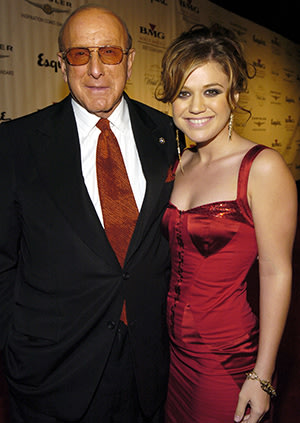
Clive Davis' Memoir Stirs Backlash from Kelly Clarkson

Clive Davis is well known for his uncanny ability to find and nurture talented artists within the field of music.  He has been responsible for skyrocketing the careers of artists like Whitney Houston, Jennifer Hudson, and Kelly Clarkson. Last month, Clive Davis released a memoir titled “The Soundtrack of My Life”, which shed light on his 52 years as an artist manager in the music business. A Hollywood Reporter book review says the memoir focuses on his artists’ journey to do things the way they want, rather than listening to everyone else. The memoir received negative attention this past week across entertainment news platforms alike.  Kelly Clarkson claimed that Davis misrepresented her in his book, and she has demanded clarification. 

According to the Wall Street Journal, Clarkson took to social media to express her discontent with the alleged falsified information written by Davis.  As a response to Clarkson’s actions, a representative of Davis released a comment stating that Davis verified his chapter on Kelly Clarkson with five independent individuals.  In this article, Clarkson expressed that Davis discouraged her songwriting and personal projects numerous times in private and in public.  Additionally, she says Davis even told her she was a terrible songwriter.  It seemed like a classic case of two different accounts of the same story until Howard Stern, the infamous radio personality, stepped in.

In this article, Howard Stern took to the radio and expressed his disgust for Davis diminishing such a talented artist like Kelly Clarkson.  In addition, he added that music business professionals often diminish talent to depict themselves as artistic geniuses behind the artist.  Fortunately, Kelly Clarkson did not remain quiet about the situation and utilized social media to rally support on the common dispute between artists and their professional staff. Social media has allowed artists to voice their personal concerns inexpensively and effectively.  In just days, Clarkson was able to diminish the accounts of Davis’ “The Soundtrack of My Life”, a work that probably took him several months to complete.

Thursday, February 14, 2013

A Negotiation Podcast Analysis

I listened to and summarized three podcasts that discussed negotiation techniques.  The first discussed mutual benefits from creating a dynamic negotiation.  The second explains that some “objective criteria” can be used as dirty tricks.  The last podcast discussed preparing research and placing value on one’s offering in negotiation.  Enjoy!

Mary Olekains discussed the negotiation process and how negotiators should have game plans, and be clear about their objectives.  She explains that negotiators must supplement this game plan with being dynamic.  Negotiators should imagine the opponent playing a different game plan. This will help the first negotiator to switch their game plan or improvise to redirect the negotiation process. Engaging in a competitive, positional game will create a “spiral process”, according to Olekains.  The moves and countermoves take up time and escalate the level of defenses on each side.  Negotiators choose from power-based game plans, rights-based game plans, and interest-based game plans.  Preventative behaviors, like “not getting personal” (or separating the person from the problem), will allow negotiators to focus on interest-based negotiation.  In order to protect oneself from power moves, one should follow with an interest-based proposal.  In “Getting to Yes” (1991), the authors discuss the benefits of adopting an interest-based proposal. In principled negotiation, one separates the people from the problem, focuses on interests, provides objective criteria, and generates numerous options (Fisher, 1991). The authors explain that “Your interests are what caused you to decide” (Fisher, p.41). This means one could have many different interests behind their position. Mary Olekains further explains what interest-based negotiation requires to move the negotiation forward. Taking a restorative turn reminds the other negotiator that an agreement will help both. Taking a participative turn will allow both negotiators to brainstorm solutions with one another. Personal attacks, requests for sympathy, and threats are moves that negotiators should counter with either a corrective, naming, diverting, interrupting, or questioning turn. Olekains ends the lecture with a scenario of making the negotiation dynamic.  Her lecture confirmed the benefits of using interest-based negotiation.  Viewing the negotiation as a path that could either spiral out of control, or that could shift and change as turns are made in the process will help negotiators see the impact of their negotiation process. In the entertainment industry, creating a dynamic game plan will allow professionals to focus on merits, while keeping the relationship professional.  Taking preventative or participative turns in negotiation can also help negotiators grow their working relationship.  As a result, both entertainment professionals benefit from the agreement.


Paula Langguth Ryan talks about the importance of facts and figures, and gaining concessions. Many times, negotiators throw out numbers.  Paula stresses the importance of breaking down the impacts of numbers on the actions of other negotiators.  She used the Persian Gulf instability and the habit of gas providers to use declining numbers to justify raising their gas prices as an example.  She explained that it is important to pay attention when people spout out numbers, because sometimes those numbers are exceptions or outliers.  Getting caught up in the numbers game will make a negotiator miss an opportunity to improve their position.  When numbers consume the negotiation, negotiators forget about the other benefits of the negotiation.  By being open to changes, and stating it in negotiation, it allows for the other negotiator to work with you to solve the problem together. In this podcast, objective criteria were discussed in a different light by explaining how negotiators use numbers as dirty tricks.  Taking the other side’s objective criteria as the rule could create an unbalanced agreement in the end.  Dissecting objective criteria will give the negotiators the correct picture of the problem, and allow both of them to move towards a possibly more balanced agreement.  One of the first rules of objective criteria in “Getting to Yes” is to agree on the standards to apply (Fisher, p.88).  This step allows both negotiators to be on the same page with the numbers game. Phony facts, as discussed in “Getting to Yes” should be combated with verifying information (Fisher, p.133). In the entertainment industry, knowing that some numbers just do not apply as the rule will help negotiators to not agree to an unfair agreement.  For example, an agent providing salaries of seasoned actors as evidence of the rule of salaries for his client should not be acceptable.  What should be acceptable, however, is providing salaries of other actors with the same experience and exposure as the client.


Brian Dietmeyer discusses how people should keep negotiation simple. Negotiation is about the problem, and how much the negotiators will do to solve the problem.  The more data analysis a negotiator completes, the smoother a negotiation will go. Whichever negotiator has the most analysis will have the upper hand at the negotiation table.  Being able to list your side’s strengths and weaknesses will allow you to prepare and clarify your argument to the other side.  Most negotiators compare an alternative or ask for a concession.  This strategy puts the other side in a strong hold to change their initial request in order to make a deal.  In order to balance the negotiation, the negotiator should prepare and analyze as much as possible to understand the needs of the other side.  If you do not know your analysis better than the other side, the negotiation will be unbalanced.  This podcast was about analysis, and preparing for the negotiation properly.  Dietmeyer believes that as long as a negotiator predicts that the opponent will provide a better BATNA, or will ask for a concession, the negotiator will prepare what they want, the value of their offering, and what the other side might say before the negotiation even starts. Most people provide BATNAs that claim they could acquire the same proposal for a cheaper price.  By researching the value of the proposal before the negotiation, the negotiator makes the game much more balanced, especially if the value of their proposal is higher than other proposals with the same price.  This idea is discussed briefly in “Getting to Yes” (1991).  The authors state that if the other side is optimistic about their supposed BATNA, lowering their expectations and giving them a reality check will balance the negotiation (Fisher, p.105). In the entertainment industry, researching what sets the offering apart from others will make the other side believe that you, as a professional, understand your craft.  A production company or music group that offers numerous services, for example, could state that their services are valued at a lower price compared to competitors because they can cut costs from bundling their services for large projects. This can help the other side possibly save money.  As a result, the negotiation becomes more balanced, and is not dependent on just the price.  Knowing the value of one’s skill could be one of the most helpful strategies while at the negotiation table.

Sources:
Fisher R., & Ury W. (1991). Getting to yes: Negotiating agreement without giving in.  New York: Houghton Mifflin.


Sunday, December 9, 2012

Will the Real Pandora Please Stand Up?


Everyone has been discussing the recent backlash of megastars as a result of the royalty cuts made by Pandora Radio.  Just last month, Congress held a hearing with the C.E.O. of Pandora, Joseph Kennedy, and other informed industry representatives (like Jimmy Jam, a representative for the Recording Academy).  This article discusses many negative effects of the failure to determine a fair way to set royalty rates for internet radio music play.  Pandora will pay over half of its revenue in royalties this year and the company’s stock is slowly taking a hit because of the losses.  Just on December 4th, price per share was steady creeping to $9.45, and on December 7th dropped to $7.97 (which is still better than the $7.19 per share on November 16th, when artists like Katy Perry and Rihanna wrote an open letter to the company about their “hurtful” royalty cuts).


     One could say artists making seven figure incomes could not really hurt from these royalty cuts. Jimmy Jam, on the other hand, puts the scenario into perspective for the middle class musicians who make the modest five figure income like the rest of us.  Jam claims that Pandora offers some musicians a tenth of a penny per play, which averages about $4 a year in revenue for the artist.  He also went on to say that most of the time, the artist only gets half of that revenue after the royalty is cut due to other expenses.  There really are starving artists struggling with greedy royalty cuts by such a huge company.  Apparently other large internet radio providers, like Spotify, have witnessed losses in 2011 as well (The New York Times).   

     One big question is how iHeartRadio seems to be just fine during such a testing time in the industry.  One answer might point to its parent company, Clear Channel Broadcasting Inc..  Clear Channel is able to use its massive backing from its other established subsidiaries to use internal funding (while companies like Spotify are invested by other companies like Coca Cola and Fidelity). iHeartRadio appeared much larger and more popular among artists from its inception, but unfortunately, Clear Channel is also losing money, with a net loss in 2011 of $300 million. 

     Maybe it is really time for a change in the industry.  With artists walking around throwing money, while literally everyone else and every other company struggles to make positive income, it’s easy to see where the real cuts should be made.  Entertainment is a necessity, but should it really cost the nation staggering losses in so many sectors of the industry? 

-RashaunahAsya

Tuesday, November 27, 2012

Profitability of Music, Games, and Film

Many speculate that the mainstream music industry is witnessing an all time low point due to the change in business processes of music creation and distribution.  If one had to compare the three largest entertainment industry sectors (film, video games, and music), how would they rank the three by profitability (by amount of revenue generated)?

             In mid 2011, an article discussed the actual worth of each industry.  CBS reported the video games industry to be a $23 billion industry, while the film and music industries both lagged behind at $10.6 billion and $6.9 billion respectively.   However, this year, retail sales of video games have dropped about 20% in the U.S. according to the New York Times), so we must put this widespread decline in revenue into perspective. Reuters.com claims that record labels are maintaining their spending on new music despite the decline in their industry.  Major labels have consolidated, merged and even disappeared in some cases during this decline. Artists are even protesting services like Pandora that have lowered music royalty rates (read more at SFGate.com) . So why are the video games industry and the film industry doing better than the music industry if every industry is experiencing some decline in revenue?

            Video games and films have much more to build on with each project created.  Video games are more interactive with their participants (as they should be).  Games are purchased, content is constantly updated, expansions and additions to the games are sold, websites and online communities are solely dedicated to the games, and festivals are attended (like the one to the right).  In the film industry, sequels and trilogies create loyal viewers (and sometimes critics) and communities are also built around the characters of the movies (with merchandise, video games, etc.). 

            In the music industry, however, the interaction must happen with the band or the artist for the fans to really connect.  The avenues for this type of interaction are fairly limited with mainstream music artists.  Interaction takes place in concerts, television appearances, and in the music itself.  Very rarely will mainstream artists take time to chat or tweet their fans, which creates a disconnect between the “product’s community” and the product itself.  Some artists will release free music or create countdowns for their fans to participate in, but that still does not come close to the interaction created in the film and video games industries. Sources of revenue are physical sales, digital sales, ticket sales, and sales related to artist merchandise (t-shirts, wristbands, etc). A movie and a video game usually cost a bit more than a music album as well.  Music may not ever be as interactive as the video games and film industries, but maybe if the music industry could tap into possibilities of their fan base communities more, major labels could achieve the same success as its fellow entertainment industry cohorts. 

Friday, November 23, 2012

Listening With Resonance

Perusing through www.Ted.com, I stumbled upon a musician of incredible talent: Evelyn Glennie. Dame Evelyn Glennie is a virtuoso percussionist and the very first full-time percussionist. She performs at least 100 performances a year, owns over 1800 instruments, and has received over 80 international awards, according to Cheryl Sucher of The Listener.  A descendent of Scottish heritage, Evelyn Glennie attended the Royal Academy of Music in London.  Such accomplishments are noteworthy for anyone, but it is Glennie’s “disability” that makes her story much more compelling.


     Dame Evelyn Glennie lost her hearing at the age of 12.  As a result, her percussion instructor focused her “hearing” music and pitches through feeling the sound waves with her body.  She uses her body as a resonance chamber and always performs barefoot as to accurately “hear” the pitches, textures and colors of the music.  Upon deciding to pursue a degree in music, Glennie was rejected by the Royal Academy of Music  on the basis that they could not determine the “future of a 'deaf' musician”.  Her response was if her acceptance was based on something other than ability, that would speak volumes for students that were, in fact, accepted into the academy.  She then auditioned once more, and was accepted.    Now, Glennie is a fellow of the London's Royal Academy of Music.


     Dame Evelyn Glennie’s real purpose in life, she says, is to “teach the world to listen”.  As musicians, we read the music and follow the instructions on the sheet music.  In other words, we translate the music.  But as artistic beings, we must do everything that is not on the sheet music for the piece to come to life. As artists, we do not just translate the piece, we interpret the music. 

     The deeper meaning behind Glennie’s story is that we as people often look at others and make initial ideas and assumptions about them, i.e. we “translate” them.  As people, however, we should be listening to others and taking time with them individually, in order to “interpret” them. We all do not interpret music and people in the same fashion, but as long as we listen to each other, says Glennie, we use our bodies as resonance chambers.

Want to read further about Evelyn Glennie? Read this article by The Listener or visit her website here

~RashaunahAsya

Thursday, October 4, 2012

What's Your Music Portfolio Worth?


How are you finding out about new artists these days? Most likely from surfing the web or from your friends.  TastemakerX is a website solely dedicated to bands and their fans. “It is a mobile, social game that enables players to build a portfolio of the artists they love, and the new ones they discover, and publish them to their social graph” according to the TastemakerX blogHere you can create your own “stock” like portfolio of artists  that you listen to, established and new.